
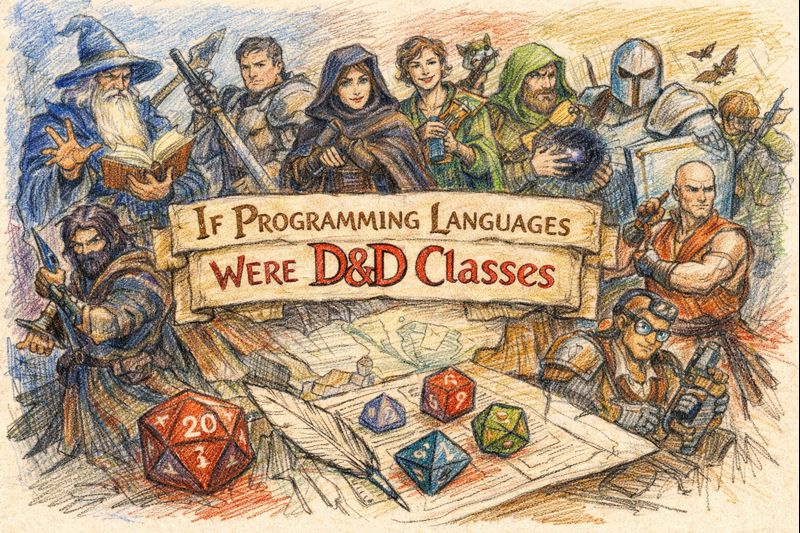
If you have ever spent time with the Dungeons & Dragons 5e Core Handbook, you know that classes are more than mechanics. They are philosophies. Each one represents a way of thinking, solving problems, and surviving chaos.
Programming languages are no different.
Every language attracts a certain mindset. Some reward discipline and preparation. Some thrive on speed and improvisation. Some feel like you made a deal with an ancient entity at 2 a.m. just to get production back online.
So for fun, let’s imagine that programming languages are adventurers and see which D&D class they most naturally represent.
Wizard – C, C++, Rust
Wizards are scholars first. They study deeply, prepare carefully, and wield immense power if they truly understand their craft.
C, C++, and Rust users live here. These languages demand respect. You manage memory, understand what is happening under the hood, and accept that mistakes will be punished immediately.
When your spell works, it is devastating.
When it fails, you learn humility fast.
Fighter – Java, C#
Fighters are reliable, disciplined, and built for endurance.
Java and C# excel in large systems, long-lived projects, and team-based development. They value structure, consistency, and proven patterns over clever tricks.
You may not feel flashy, but your code survives refactors, handoffs, and years of real-world use. That is its own kind of heroism.
Rogue – JavaScript
Rogues are quick, adaptable, and occasionally a little dangerous.
JavaScript slips everywhere. Browsers, servers, desktops, embedded systems. It thrives on flexibility and creative solutions, even if the rules feel optional at times.
You can solve problems faster than anyone else in the room.
You can also trip a trap because null and undefined had other plans.
Still, when speed matters, the rogue goes first.
Cleric – SQL
Clerics keep the world standing, whether anyone notices or not.
SQL is not flashy, but without it, nothing works. It stores, restores, and protects the most important resource in any system: data.
When applications fail, SQL is still there.
When mistakes happen, SQL is expected to fix them.
Underappreciated. Absolutely essential.
Bard – Python
Bards are versatile, expressive, and good at almost everything.
Python scripts, servers, automation, data science, AI, and tooling all live comfortably under one roof. It is readable, friendly, and powerful without trying to be intimidating.
Python users solve problems with charm and clarity. Sometimes they accidentally create something elegant while they were just trying to get through the day.
Warlock – PHP
Warlocks gain power through questionable pacts, but the power works.
PHP has grown up a lot, but its reputation still comes from ancient spells written long ago and never questioned again. And yet, the web still runs on it.
It may not be beautiful.
It may summon legacy horrors.
But production is up, and the site loads.
The pact holds.
Druid – Bash, Shell Scripting
Druids shape the natural world rather than fighting it.
Shell scripting works with the operating system itself. Pipes, processes, permissions, and files all bend to your will, until they don’t.
When it works, it feels like magic.
When it breaks, you stare at it like it is a wild animal.
You do not debug Bash. You reason with it.
Paladin – Go
Paladins follow rules for a reason.
Go emphasizes clarity, simplicity, and correctness. It quietly pushes developers toward good habits and away from unnecessary complexity.
Less expressive, more disciplined.
Straightforward, fast, and dependable.
Code you can trust, even when things get stressful.
Monk – Kotlin, Swift
Monks value balance, efficiency, and clean motion.
Kotlin and Swift remove friction and encourage expressive but controlled code. They do not force minimalism, but they reward it.
When written well, everything flows.
When mastered, they feel effortless.
Artificer – Python, JavaScript, and Whatever Else Works
Artificers care about results, not purity.
If your solution involves scripts, APIs, cron jobs, databases, and duct tape held together by documentation, you are an artificer.
You build tools.
You solve real problems.
You absolutely have a folder called “final_final_v3”.
Closing Thoughts
Just like D&D classes, no language is inherently better than another. Each one represents a different way of thinking, a different tolerance for risk, and a different approach to power.
Most real-world systems are not single-class heroes anyway. They are multiclass parties stitched together over time, shaped by deadlines, experience, and necessity.
The real question is not which class you play.
It is whether your party composition can survive the next production dungeon.
Happy gaming to you and I would love to hear your thoughts in the comment section 🙂
Leave a Reply